Thursday, October 17, 2013

When was the last time you went to a Tonsorial?

I was watching "Gunsmoke" and Chester said that he was going to the Tonsorial. Anyone that knows how much I like to study "words," will guess what happened next. I had to stop and look it up -- "pertaining to barbers," 1813, from Latin tonsorius "of or pertaining to shearing or shaving," from tonsor "a shaver or barber," from tonsus, past participle of tondere "to shear, shave." . 

Now we know where Chester was going -- the barber shop.

SOURCE: http://www.etymonline.com/index.php?term=tonsorial

Wednesday, October 16, 2013

The Rise of the Market Society

Do you know what a Petrodollar is? If the answer is "No," then you are incapable of understanding what is going on in the US economy and political system today. Below is a chapter from an unpublished book I am working on. I hadn't planned on publishing it until later, but with the current debt crisis, I felt that I should go ahead and put this chapter out there (even though the final editing hasn't been completed). Please keep the following in mind as you read it.

Alexis de Tocqueville believed the essential requirements for America to become the nation envisioned by the Founding Fathers, a democratic power that would be a light of freedom for all peoples, American citizens must accomplish the following:

(1) Learn to voluntarily help one another.
(2) Associate with one another for political purposes.
(3) Acquire the habit of forming associations in ordinary life.
(4) Acquire the means of achieving great things by united exertions.

An essential component in accomplishing this is for citizens to have the facts and be able to distinguish between facts and propaganda. As you read the following chapter, ask yourself if you were given these facts by the government, political parties, the media or were taught them in college or a public school. If you didn't get the facts from that list of institutions, then maybe its time for us to do the four things above and change them. 

[beginning of chapter]
The Rise of the Market Society

Wall Street created a disaster in the 1920s when bankers decided to become actively involved in speculating in all kinds of risky and volatile financial products -- from common stocks to debt-instruments of weak third world nations. Banks and brokerage firms hired armies of salesmen to go door-to-door selling these products to ordinary people who had no concept of what they were buying. In addition to investing in things of great risks, many also bought them on high interest credit too.

When the investments began to fail, so did the banks that sold and financed them. Between January 1930 and March 1933, about 9,000 banks failed and wiped out the savings of millions of people. There was also less money available for loans to industry, which caused a drop in production and a rise in unemployment. From 1929 to 1933, the total value of goods and services produced annually in the United States fell from about $104 billion to about $56 billion. In 1932, the number of business closings was almost a third higher than the 1929 level.[i] Americans faced the greatest threat to their economic survival in the decade of the 1930s -- and then December 7, 1941 arrived.

On an otherwise calm Sunday morning on December 7, 1941, the Japanese shocked the world by bombing the American naval base at Pearl Harbor, Hawaii. Over 3,500 Americans were killed or wounded in 2 waves of terror lasting 2 long hours. 350 aircraft were destroyed or damaged. All 8 battleships of the U.S. Pacific Fleet were sunk or badly damaged - including the U.S.S. Arizona. And yet all of America's aircraft carriers remained unscathed. On December 8, the nation was gathered around its radios to hear President Roosevelt deliver his Day of Infamy speech. That same day, Congress declared war on Japan. On December 11, Congress declared war on Germany. The slogan “Remember Pearl Harbor” mobilized a nation and helped awaken the mighty war machine and economic engine that is America.[ii] 

World War II saved America from the Great Depression and united American citizens as they had never to be united before. Everyone became an American first, whatever else second.  Millions of men and women entered military service. With so many Americans serving in the military there was a great shortage of labor in industries that made the supplies needed to fight the war. In many cases, women that had been wives and mothers stepped up to the plate and took those jobs – jobs that had been the exclusive domain of males before.


SOURCE[iii]

America emerged from the war as the most powerful and wealthiest nation on the face of the earth with 80% of world’s gold sitting in US vaults.[iv] The US dollar was increasingly taking over the function of gold as a major international reserve asset. This made it possible for the US to be the dominant economy and allowed it to run a trade deficit without having to devalue the dollar.[v] The US military was also at the height of its power, with weapons that included atomic and hydrogen bombs. Mankind had reached a point that made it possible to destroy itself with its own creations.

Men who joined the military as teenagers came home after the war as adults. Many had been to places and seen things beyond what they ever could have imagined. The nation wanted to thank them for their service and one way Congress decided to do it was the G.I. Bill of Rights.  The law gave the following benefits to U.S. soldiers coming home from World War II:
● education and training opportunities
● loan guarantees for a home, farm, or business
● job-finding assistance
● unemployment pay of $20 per week for up to 52 weeks if the veteran couldn't find a job
● priority for building materials for Veterans Administration Hospitals

For most, the educational opportunities were the most important part of the law. WWII veterans were entitled to one year of full-time training plus time equal to their military service, up to 48 months. The Veterans Administration paid the university, trade school, or employer up to $500 per year for tuition, books, fees and other training costs. Veterans also received a small living allowance while they were in school. Thousands of veterans used the GI Bill to go to school. Veterans made up 49 percent of U.S. college enrollment in 1947. Nationally, 7.8 million veterans trained at colleges, trade schools and in business and agriculture training programs.[vi]

After the war, business was good in America, employment was high, and for many the American Dream was becoming a reality. There was a factor that was unrecognized in the post-war prosperity that many didn’t understand. It was that the economies of other nations had been harmed or destroyed by the war and America had little competition in rest of the world. Also, as a result of the Bretton Woods Agreement reached in 1944 by the 730 delegates from all 44 Allied nations, America played a major role in creating the plan for rebuilding the international economic system after the war.

The World Bank (officially the International Bank for Reconstruction and Development) was set up to make long-term loans "facilitating the investment of capital for productive purposes, including the restoration of economies destroyed or disrupted by war [and] the reconversion of productive facilities to peacetime needs."[vii] The bank’s mission was a huge success. By the end of the 1950s, nations that had been the enemies of the US in the war were rebuilding their economies and becoming competitors to American corporations. One of America’s greatest challengers was Japan.

As foreign companies became more successful in selling their products in US markets, foreign banks acquired increasing amounts of US dollars. Beginning in 1963, foreign central banks requested that their dollar reserves be converted into gold by the US. By the end of the year, gold reserve at Federal Reserve Bank of New York could barely cover its liabilities to foreign central banks. By 1970, the US gold reserve at FRB New York covered only 55% of the liabilities to foreign central banks. One year later, it was down to 22%. From January to August, $20 billion in US gold assets left the US for other countries.

On August 15, 1971, President Richard M. Nixon, without the approval of congress, changed the US monetary and banking system.[viii]  This weakened confidence in the US dollar and created a major crisis for Nixon. He was searching for a solution when, on October 6, 1973, Syria and Egypt launched a surprise attack on Israel. Nixon sent supplies to Israel and the Arab League responded by pressuring King Faisal of Saudi Arabia to stop Aramco from delivering oil to the US. The US was fighting a war in Viet Nam and needed oil for the military. Something that many people do not know is that Aramco was owned by Standard Oil California, Texaco, Standard Oil of New Jersey, and Mobil Oil Company. They received 50% of the profits from Aramco, while the other 50% went directly to King Faisal. With Saudi oil off the market, world oil prices quadrupled.

Nixon sent Secretary of State Henry Kissinger on a secret mission to King Faisal. Kissinger told him that Saudi oil was a US national security priority and, if necessary, the US would use the military to intervene to restore the flow of oil. Faisal secretly arranged for oil shipments to be delivered to the US Navy until the embargo ended in 1974.[ix] Kissinger negotiated another secret agreement and it changed the course of history. Pay close attention to the details:

● Saudi Arabia only accepts US dollars in payment for oil.
● Saudi Arabia invests excess profits in US Treasury bonds, notes, and bills.
● United States military protects Saudi oil fields.

Nixon solved the dollar problem. He switched the dollar from the “gold standard” to the “Saudi oil standard” -- and created the petrodollar.  Look at what happen to the US Money Supply after America switched to the “Saudi Oil Standard.”


Now, as Paul Harvey used to say, here is the rest of the story. Take out a dollar bill and look at it. At the top you will see the words “Federal Reserve Notes.” A “note” is an “I.O.U.” – a debt instrument. The creation of the dollar you are holding required a debt of $1 to be created. Can you guess what happened when the US Money Supply increased so dramatically to produce the dollars needed to buy all of OPEC’s oil?


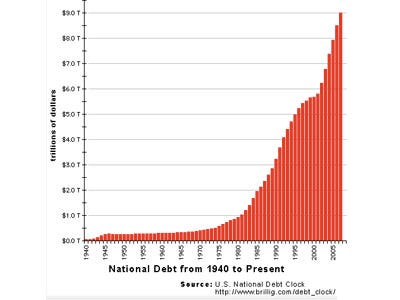
The “T” on the left side of the graph stands for “trillions.” Take another look at the years 1959 to 1974 on the “Money Supply” graph. The entire US economy operated with a fairly level amount of money. The same is true for the amount of debt. Notice that even in the years America was engaged in major wars, the amount of debt remained fairy level too. America’s economy shifted from an economy based on the production of real goods and services to a financialized economy based on financial products and speculation. Professor Noam Chomsky provides very valuable insights about what happened.

The most important changes took place when the Nixon administration dismantled the postwar global economic system, within which the United States was, in effect, the world’s banker, a role it could no longer sustain. This unilateral act (to be sure, with the cooperation of other powers) led to a huge explosion of unregulated capital flows.

Still more striking is the shift in the composition of the flow of capital. In 1971, 90% of international financial transactions were related to the real economy – trade or long-term investment – 10% were speculative. By 1990 the percentages were reversed, and by 1995 about 95% of the vastly greater sums were speculative, with daily flows regularly exceeding the combined foreign exchange reserves of the seven biggest industrial powers, over $1 trillion a day, and very short-term: about 80 percent with round trips of a week or less.[xii]

The old economy produced jobs and economic opportunities for the masses, but the new economy did not. The goal and mission of CEOs was to maximize shareholder value. This marked the shift from a market economy (old economy) to a market society. A market economy was a tool, a valuable and effective tool, for organizing productive activity. It was a way of life in which market value did not invade everything aspect of life. But, a market society is a place where everything is up for sale and shareholder value is a higher priority than human life.[xiii] This took place in America without any serious public debate about where markets served the public good and where they did harm to the public -- and didn’t belong.

In the new market society, many Americas were surprised to learn that in Iraq and Afghanistan, there were more paid private military contractors on the ground than US military troops. This discussion was also made without explicit public debate. Citizens were never asked whether they wanted to outsource war to for-profit private companies. There are now a growing number of for-profit prisons and, in some California jails, if you don’t like the standard accommodations you can buy a prison cell upgrade.[xiv] Today, it would be hard to find anyone in America that believes that money doesn’t affect the quality of justice people receive. O. J. Simpson and Lindsay Lohan obviously were treated very differently that the thousands of poor that find themselves in the justice system.

The shift from a market economy to a market society resulted from the convergence of many factors -- the loss of America’s dominance in world markets, the Civil Rights Movement, the rise of liberalism, the flood of petrodollars, the transition to financialization, the loss of interest in self-government by citizens, an organized corporate conspiracy, the use of lobbyists to manipulate government, tax havens, and unregulated over-the-counter markets driven by unregulated speculation – to name a few.

This shift marked a decisive period in the demise of the role of citizens in self-government and the goal of living a “good life.” One of the primary factors in this shift was the rise of contemporary liberalism which focuses on individual rights. According to this liberalism, liberty does not depend on our capacity as citizens to share in shaping the forces that govern our collective destiny. Liberty depends on our capacity as individuals to choose our values and ends for ourselves.[xv] In other words, liberty means everyone can do their own thing. The new image of freedom became that of individuals as free and independent selves, unbound by moral or communal ties they had not chosen.

Freed from the dictates of custom or tradition, the liberal self is installed as sovereign, cast as the author of the only obligations that constrain. This image of freedom found expression across the political spectrum. Lyndon Johnson argued the case for the welfare state not in terms of communal obligation but instead in terms of enabling people to choose their own ends.[xvi] History makes it clear that simply dumping tons of money through entitlements to people who do not share a communal obligations or have any accountability for their actions will not produce the results that make our nation a better and safer place. It creates a mass of dependent people that rely on things provided by others with needs that continually increase. 

During this period when jobs were desperately needed by people being helped by Johnson’s “Great Society” programs, shareholder value driven CEOs changed the way they viewed businesses. In the old economy, a business was viewed as a whole and its value included the values it provided for its employees and the community. The new economy viewed a business as a group of individual components that were valued by their market values. Each component was classified as an asset or liability that produces profit or loss. Anything other than monetary value was secondary. Components were kept or sold based on an immediate effect on shareholder value. The fact that longtime employees lost their jobs or and the economies of local communities were destroyed were just part of doing business. In 1969 alone, there were 6000 acquisitions, and over the decade of the sixties, almost 25,000 firms ceased to exist as a result of mergers.[xvii]

The flood of new money created by the petrodollars didn’t make things better for people who needed jobs. Predators created one of the most lucrative fads in history – the leveraged buyout, or LBO. Leverage is debt and the new fad was using massive amounts of debt to buy companies. As a dangerous form of leverage, LBOs rivaled the pyramid holding companies of the 1920s.[xviii] In a basic LBO, a company’s managers and a group of outside investors borrow money to acquire a company and take it private; the company’s own assets are used as collateral for the loans, which are repaid from future earnings or assets.[xix]

This completely changed how management, specifically CEOs, could make huge amounts of money – without the need of existing shareholders, employees and customers. The story of the Burlington Industries LBO makes this very clear. Ron Chernow includes a very good overview of this event in his award winning book, The House of Morgan: An American Banking Dynasty and the Rise of Modern Finance. Important points have been underlined for emphasis.

In early April 1987, reports surfaced that raider Asher B. Edelman was accumulating stock in Burlington, the largest textile company in America, based in Greensboro, North Carolina. Frank Greenberg, Burlington’s chief executive, cast about for a “white knight” to ward of Edelman and his partner, Dominion Textile of Canada. In a meticulous reconstruction of events published in an August 1987 issue of Barron’s, Benjamin J. Stern chronicled what happened next.

On April 15, thirty-two-year-old Alan E. Goldberg of Morgan Stanley telephoned Greenberg and said Morgan would be interested in buying Burlington while retaining current management.  In a follow-up letter of April 21, Bob Greenhill reinforced the naked appeal to Greenberg’s self-interest, saying, “We would have no interest in proceeding except upon a basis agreed to by your management.”

At an April 29 meeting with Greenberg, Morgan Stanley laid out plans to give management a 10-percent stake in the buyout, plus another 10-percent if certain performance standards were met.

Facing a clear-cut choice between a hostile raider, who threatened his livelihood, and the Morgan LBO fund, enticing him with lucrative incentives, could Frank Greenberg render a fair, impartial judgment for his shareholders? As Benjamin Stern noted, Morgan Stanley customarily dangled before management promises of salary increases ranging from 50 percent to 125 percent after a buyout. In this tempting situation, Greenberg granted some exceptional concessions to Morgan Stanley. He agreed to give Morgan a $24-million “break-up” fee in the event it failed to acquire Burlington.

Morgan Stanley justified this princely fee by citing interest it would allegedly forgo by locking up capital during the talks. Yet, as Stern noted, Morgan Stanley had no capital at risk until the taker’s completion – and then only $125 million of its own money. The break-up fee, however, worked out to interest that would have accrued on $7 billion over a two-week period. As Stern concluded, “The `breakup’ fee could be understood only as a form of payoff to Morgan from its partners on the Burlington board for being included in the deal in the unlikely event that the deal cratered. It simply made no sense otherwise.”

Greenburg waited until mid-May before disclosing his secret talks with Morgan Stanley, which was privy to company secrets denied Asher Edelman and Dominion. It was hard to see how both bidder groups were being accorded equal treatment.

In late June, the Morgan Stanley group made a bid of $78 a share, or about $2.4 billion, for Burlington, defeating the Edelman raid. It got about a third of America’s largest textile company for only $125 million and even most of that came from Bankers Trust and Equitable Life Assurance. It also earned $80 million in fees, including profits from underwriting almost $2 billion in junk bonds to finance the deal. Did Burlington profit equally with Morgan Stanley from this financial alchemy?

Before the buyout, the firm had a clean balance sheet, with debt less than half the value of common shareholders’ equity. When the LBO went through, the company suddenly struggled with over $3 billion in debt, or thirty times as much debt as equity. It subsequently had to fire hundreds of middle-level managers, sell off the most advanced denim factory in the world (ironically, to Dominion Textile), close its research and development center, and starve its capital budget to $50 million for a five-year period. All this not only upset the lives of Burlington employees, but drastically weakened the firm’s ability to compete in global markets.

By the last quarter of 1987, Burlington Industries was losing money despite higher earnings from operations. Why? It had to pay $66 million in interest for the quarter. There were profound political and social issues at stake in the LBO fad. Participants hailed the trend as a return to the “good old days” when bankers put their own capital at risk. They didn’t look closely at that history and the conflicts of interest that had resulted from executive coziness between bankers and the companies they financed.[xx]

It is clear who benefited from this LBO – Morgan Stanley, Burlington’s upper management, and the other banks that made the loans, arranged for the junk bonds, and collected huge fees. Who were the ones that were harmed by it – shareholders, employees, communities, and suppliers, to name a few. Now multiply this by the thousands of other companies that were affected by this predatory fad that swept across the world’s economies. But this was just a prelude for what would follow in America’s new financialized market society. [end of chapter]

The process of change begins citizens having facts so they can work together, instead of a steady stream of engineered propaganda designed to to separate and polarize the citizens of the greatest nation on earth. The government is not going to fix things -- neither are political parties, lobbyists, or anyone else who derives their wealth and power from the existing system -- especially "the 1%." So who is left?

"If not now when, if not you -- who?


[iv] Bankruptcy of Our Nation: 12 Key Strategies For Protecting Your Finances in ...  By Jerry Robinson; p. 120
[viii] Bankruptcy of Our Nation: 12 Key Strategies For Protecting Your Finances in ...  By Jerry Robinson; p. 122
[xii] Profits Over People: Neoliberalism and Global Order By Noam Chomsky © 1999; Seven Stories Press, New York, NY; p. 23.
[xv] Public Philosophy: Essays on Morality in Politics By Michael J. Sandel © 2995;Harvard University Press, Cambridge, MA; p.20.
[xvi] Public Philosophy; p. 21.
[xviii] The House of Morgan: An American Banking Dynasty and the Rise of Modern Finance by Ron Chernow © 1990; Grove Press, New York, NY; p. 693.
[xix] The House of Morgan; p. 694
[xx] The House of Morgan; p. 694-698.

Wednesday, September 18, 2013

Republicans and Democrats both appeal to the idea of neutrality

Harvard professor Michael J. Sandel, in his book Justice: What’s the Right Thing To Do? (p. 247), provides two very interesting insights into way Republican and Democrats appeal to the idea of neutrality.

Both major political parties appealed to the idea of neutrality, but in different ways. Generally speaking, Republicans invoked the idea in economic policy, while Democrats applied it to social and cultural issues.

Republicans argued against government intervention in free markets on the grounds that individuals should be free to make their own economic choices and spend their money as they pleased; for government to spend taxpayers’ money or regulate economic activity for public purposes was to impose a state-sanctioned vision of the common good that not everyone shared. Tax cuts were preferable to government spending, because they left individuals free to decide for themselves what ends to pursue and how to spend their own money.

Democrats rejected the notion that free markets are neutral among ends and defended a greater measure of government intervention in the economy. But when it came to social and cultural issues, they, too, invoked the language of neutrality. Government should not “legislate morality” in the area of sexual behavior or reproductive decisions, they maintained, because to do so imposes on some the moral and religious convictions of others. Rather than restrict abortion or homosexual intimacies, government should be neutral on these morally charged questions and let individuals choose for themselves.

What strengths and weaknesses do you see in each position? Can you think of something better?


JM

Is Life still a "many splendored thing"?

Do people going about daily in their social interconnections create activities or movements that, like the earth they stand on, follow Nature? (Photo by http://naldzgraphics.net)
[Sunrise image by naldzgrapics.net]

By Dan Bodine                                                        


Today's tendency among many people to “blame and complain” about something on one hand while complacently refusing to get involved in any remedial effort to help solve or correct it on the other is probably as old as Adam.

It's accented in our modern state by the U. S.'s move toward setting up a permanent safety net, or welfare state. Independent entitlement payments weaken bonds of dependency upon each other.

“If it ain't my dog involved, what're you up here in my face about it for?!” is the common street buzz now.

It's a put-off answer as old, indeed, as there've been competitive, economic markets probably. The old saw, “depending on whose ox is being gored,” didn't arise from some Arabian magical lamp.

A big difference today, of course, is the larger scale--when needs go unanswered, or critical projects can't be completed—of failure. Since society in general bears the brunt of it, the imprint of it is larger.

Indeed, lack of help on a project, or contributions needed to finance its completion, is Society's silent thief in many ways.

People will never know individually, for instance, what they could've been or could've done by not getting involved, nor what their country could've become. They've sat back silently and exchanged a certain degree of comfort for mediocrity (regardless if the exchange is real, false, or imagined upon them).

But is the welfare state – coming hand-in-hand, as it has, with a technological revolution -- the chicken or the rotten egg? It appears we're either tragically cruel or arrogantly indifferent at times. One answer lies in the degree of differences you'll accept in a class society, has been my usual reply.

Indeed, some look at our situation today and see us “slouching toward Gomorrah.” But historians, too, will point out it's a re-occurring theme thru the history of our civilization. Like good rainfall on parched lands, threatened lakes will re-energize with some good rains.

Some fishing holes will come back; some are gone forever -- existing only as a vague, rose-colored memory of a once was to someone – as the Earth continues to spin seemingly indifferently on its axis thru the changes.

Along with this — in rhythm with it at times even -- the natural condition of human sloth breathes upon us in larger or smaller degrees. It's been around probably as long as sexual discretion. Or at least since the Garden eviction, for sure. It's been a he-said/she-said world since. Exponentially expanding and contracting, too!

This whole topic was raised by my ol' blogging friend Jim Myers in an earlier post on The Country Cogitator.

For maybe 25-30 years he's donated his time to youth sports. No doubt he's keenly aware, for instance, of the problem of having angry parents in your face on one hand, because of a personnel decision, i.e., versus their invisibility when finances or help for common projects are sought.

There're people who give, and people who take. Sometimes forever; sometimes depending upon the year, or the season. Life tends to move in patterns that track how they're used, or not used in life.

Indeed, it's probably the oldest con game around. What many don't fully realize though is exactly who is doing the conning, and who is being conned.

In exponentially higher situations—which, yes, covers much of our stressed-out modern era—often the conner and the connee are one and the same.

When truth comes to that person thru enlightenment or revelation (e.g., a burning bush or a wife's skillet on the back of the head!) … Ah, then action! It explains why progress in the world moves in pulls and jerks—Folks pulling along fine here; then a group suddenly jerking there, to break things up. For what? Progress?

This is scattershooting some, of course, for I've spent the past 25 years in poor border communities on the Rio Grande. But most differences Jim and I (or any two people, really) may have gathered in our lives, vary according to how we've perceived class situations locally.

Human nature is human nature – even though overriding it to a certain extent, still, is a deep belief in the basic goodness of men and women.

But a common response, yes, anyone will encounter today in asking for community help is, flatly, “No I don't want to get involved”; or “No I can't get involved.”

It means the cause against the causee isn't popular enough yet with some of my social or financial connections for me to risk breaking them, not without, in the sum aftermath, of getting hurt individually in some way for it.

In becoming a diversified society, it appears not only have our differences been magnified but also the differences separating us, the intensity of our feelings, have grown, too.

The question of where or when that critical breaking point of too much will occur still lingers, however. And if history is still an indicator, a relapse to pulling in peace will settle back into the country for awhile.

Thus if “Peyton Place” chronicled the interconnectedness of the 50's village, Miley Cyrus and her twerks now reflect our separateness in the early 21st decades. But history hasn't written its next chapter yet, one can always argue.

Was social policy the chicken or the egg in all this? Or technology? The government's safety net, in effect, has made folks less dependent on each others' oxen, for instance. They have an additional source of revenue--government.

If a sacred cow gets gored, so what? But entitlements are iffy, flowing with political correctness. Technology has muddied (prolonged?) this cycle of change, essentially, by creating new opportunities.

The internet and YouTube et al, i.e.,  give you the freedom and opportunity to make another one! A connection. Another cow. And the beat goes on! We're still not holding hands together though.

If there's any relief for wearied old-timers – like Jim and I are rapidly becoming (in the face of this new-age thinking) -- it's in our awareness of history.

“This, too, shall pass” is a refrain we've lived thru sufficiently enough for it to be a true lesson.

The problem with growing old though is time. It shortens tolerance. And there's just not enough of it to listen to or to watch all this stuff! Meaning change our lifestyle cadence; to get in step with the times.

Hee, hee. That's why you see so many in the older generations spending so much time at domino tables somewhere. Or at home in their gardens.

They're elected to continue to keep up with what once was, rather than what now is. It's less disruptive. And it's still a free country.

Until another Big Jerk comes along. And forces them to do something out of their routine. For better or for worse.

Life. It's still a many splendored thing.


--- 30 ---


Sunday, September 8, 2013

Blame & Complain or Engage & Fix It

Have you noticed how many of the memes – pieces of information -- you find in your emails, on your Facebook page, receive via Twitter, see  on TV, to name a few, are about blaming and complaining? It is as if millions of people have had their brains programmed to believe that their most important role in life – the purpose of life – is to find someone to blame and then complain about whatever upsets them:

I have found someone to blame, I have told as many people as I can who to blame for whatever it is, and I complain about it every chance I get – I have accomplished my purpose for existing.  

Have you ever been around a place where a bunch of chickens lived? When I was a kid my grandmother had a “chicken yard” where she raised her chickens. I really enjoyed going with her to feed them and collect the eggs. The moment she opened the gate and we took the first steps inside – the chickens started squawking. As we walked towards their nests, they squawked louder and louder. They didn’t only squawk; they also ran away. Oh yeah, there is one more thing you could count on them doing – and you made sure you didn’t step in it. When I hear all of the blaming and complaining going on today – I think about those chickens.

But, I will be eternally grateful to some of the men who were my bosses and mentors in my early years of business management. By the time I was 20 years old, I was branch manager of a consumer finance company and responsible for over $1,000,000 in loans. My boss was teaching me some of the tricks of the trade one day, when he said, “When problems arise, most people spend their time trying to find someone to blame or just go around complaining about it. But the ones who succeed and are promoted to higher positions in the company -- investigate to find the causes of the problem and then take the steps required to solve the problem. His slogan was – Are you going to blame and complain or fix it!

So, why has blaming & complaining become like a virus of the mind for so many Americans today? I think the media, especially the news programs, plays a major role in creating this problem. News programs, especially on TV and politically charged talk radio, have evolved into entertainment programs instead of reliable sources of accurate information. We all know which programs support the Democrats and which support the Republicans. Instead of doing what reporters used to do, go out and investigate the matter and report the results in a way that could be understood by the audience, today they invite a few people from each side to come and try to persuade the audience to believe them. Showmanship is much more likely to be a greater factor than accurate information.

The goals of all of those involved appear to be to manipulate the emotions of the masses instead of accurately informing them – and that includes the reporters – who are making a whole lot of money when they drive up the ratings. I know a lot of them say that fame and lots of money doesn’t affect how they do their job – but I really have a hard time believing that one!

One thing about getting old is that you see a lot of things just because you happened to be alive when they took place. And, as long as the old memory works, you can compare similar things that you have seen throughout the years to each other. When I watch today’s star reporters, I think about another reporter that I heard a lot about when I was just a kid -- Edward R Murrow. If you have a few minutes watch this short video -- Edward R Murrow vs Joe McCarthy -- http://www.youtube.com/watch?v=e4LZsDqSSfk . I think it will give you a taste of what news reporting could be about.

Reporters like Murrow worked hard to dig and dig until they came up with facts and then reported them in a way that helped their audience understand, so they could see the entire picture. This brings up another important point – and a major problem that is continually ignored -- the increasing inability of the audience to engage in critical thinking so they can understand the facts. Reporting the facts doesn’t accomplish much if the audience can’t understand what those facts mean.

Another great reporter, in my biased opinion, is my co-cogitator Dan Bodine. He has been a reporter and editor for a number of newspapers. Watching Dan work on a story always reminded me of an old hound dog following the scent of the thing it was after. He would just keep on sniffing here and there until he found what he was looking for. I remember times when what he found were things that some pretty powerful people really didn’t want him to share with his readers. But somehow or another, he would usually find a way to get that information in the paper. Hopefully, he will cogitate on my comments above and share some of his thoughts on those subjects.


Finally, I would like to invite everyone that reads this to cogitate on it too and see what ideas we can come up with that will get us on the road to fixing it. You know, this is really a strange predicament to be in – in the information age! 

Tuesday, September 3, 2013

Count your doves after this new "paradigm" hatches!

By Dan Bodine


A new paradigm!

“A new paradigm! it is. I'm telling 'ya, we've entered a new paradigm!”

Hee, hee. I've been hearing this new stuff since my first wife got pregnant from a Chinese Mynah bird almost 40 years ago, that day when I lost her several hours at the Waco Zoo!

We're living in a New Reality now! Expect the unexpected! all this buzz is.

But I'm still broke. Last week's doctor bills are still coming two months early. And the only way I can still stay sane is to go talk to some of my plants “out back.” Where's the Big Step Up?

I don't know what's new about all this. Other than you can “git broke” and run up doctor bills at least three times as fast now as any other time in our nation's history.

I was thinking about this riddle of new finance transformations yesterday, when I came upon a white-wing dove in our back yard. A little angry, she was.

Birds in our yard, first of all, aren't uncommon. We moved to the Las Tierras (insane) neighborhood of East El Paso over three years ago. Even then there were over 25,000 people living here, all squeezed together like angry mother-in-laws without arms. There may be 50,000 now.

But there were a lot of birds hanging around, too, making themselves at home – white-wing doves and many collared doves of some kind, really tame; fussy pigeons (more on Chief Huff-Puff Whappo later, maybe); and of course, sparrows.

Most of them, in fact, do live in the Las Tierras, I feel. On almost every house, in some nook or cranny of the roof-line, you can find their nests. The thing that bothered me though, the Las Tierras being a fairly new subdivision, was food. Where do they get it?

With very little landscaping around most of these desert houses to attract a food chain -- How far are they having to go to get food, I wondered? And then making it back here in time to sack out for the night? Jeesh! What a life, pobresitos!

Last March (2012), stressed out over three months of continuous sickness, staring at these birds daily on fences or rooftops (they strangely stay home in the winter, mostly), I upped and made God a promise.

I'll feed these damn birds for 'ya if'n you'll get me out of this sickness! Whaddaya think?

Wasn't exactly thunder or lightning that followed, and certainly no burning bush around, but I felt a gentle thump-thump in my chest. Affirmative, I took it. So off I was on the great bird project!

Lasted over a year (Yep, almost immediately my health got better, too); and damn near put me in the poor house just from buying birdseed! Forty pounds a week eventually!

But you can imagine after a month or so, where you'd find the majority of the wild birds in the Las Tierras most mornings—on fences and rooftops around ol' Bo's backyard waiting for El Whacko to come out with morning chow!

Thus I became a tad-bit unpopular among my neighbors. The poop was piling up everywhere!

In May, under the threat of a health lawsuit by the Mormon woman immediately behind me (she wadn't impressed at all that the poop may've been divine), I stopped the practice. And of course, in a few weeks, the birds had thinned back to normal.

I've always put out water for them, since moving in. Thus it's not unusual to find a half dozen or so flying around “out back” just about any time you go back there. Even now.

Coming across the white-wing yesterday was a little different though. She was walking. Casually.

Now the second of my great projects that's not sitting too well with my neighbor behind me is that I have a lot of plants. Trees, shrubs, bedding plants. Had to build some shade for them, those things, but I was up to. Barely.

But it means you must water often. Which attracts insects. In the desert, in summer, sometimes you can't go a day without watering some of the younger ones.

Thus yesterday, “out back” when I was pulling the water hose and doing my watering, I came across the white-wing.

She came ambling out from underneath a big arbor I'd built near a rear corner. Looked at me fussy-like, she did; and then ambled on over to another plant I'd already watered, and got under it. Had no intention of leaving, her attitude said.

Hmmm... I thought. She doesn't appear to be injured. No marks. What's the deal?

I continued watering, finishing up with a number of cross-Desert Willows in small pots I've kept alive since rooting 'em over winter, and was making my way with the hose back around the arbor, when she jumped out from underneath a tall cedar.

JULIETTA
And her nose stuck high-'n-mighty in the air, took her time again in ambling back across my path and underneath the arbor again to, this time, beneath a large Philodendron I've named “Julietta” in memory of a friend back in Presidio.

And this time something clicked.

This is a mama bird! I thought. A mama-in-the-making, a mama wannabe, some kind of mama! And she's either built or is building a nest back in there somewhere! … Holy cow! You know how much you can sell those little suckers for, once they're old enough you can take 'em away from her, huh!?

And then that kind of New Reality thinking was quickly chased away by some Old Reality thoughts.

You got four dogs, Bodeen! Three of 'em spend most of their time policing this back yard to make sure none of the neighbors' cats are lurking about! A mama bird wants to raise a brood back here?!!

When I turned back around to the Philodendron, she'd already walked away somewhere. But I squirted water over toward it anyway. Just to leave a message.

“Shoo!” I said “Waddaya think this back yard is?! … A'new paradigm' for 'ya!!”

Today she wasn't out there.

That's what I like about back yards and gardens.

You can still make some old-fashioned sense of things!


--- 30 ---

Sunday, September 1, 2013

Don’t look at the moon through tree branches if you don’t want your house to burn down!

Dan’s cousin Baldy, probably in his middle teens, was a great joke & story teller. We were a few years younger than Baldy and all three of us worked for my dad at Myers Plant Co. – “Home of 50,000 plants.” Dad often put us to work with a sophisticated advanced technological tool called a “hoe” – a word that has definitely changed its meaning since we were kids.

When we were out in the field hoeing, Baldy would become like a “divinely inspired prophet” -- a channel through which endless jokes and stories would flow. Of course, an important part of this prophetic ritual was that it required Baldy to stop hoeing and used the hoe handle like a staff --  kind of like you see Moses leaning on. Of course, we had to also stop hoeing so we wouldn’t miss anything.

One day, after a house had caught fire and burned a few nights earlier, Baldy shared a mysterious insight from his wisdom, along with a deadly warning, with us. He pulled us in close and revealed to us why the house had burned -- he had looked at the moon through the branches of a tree the night of the fire. He warned us never to do it or our houses would burn too. Now Dan and I knew the secret and understood the burden that Baldy must have been carrying on his shoulders. He had caused the fire.

I remember many times in my life, beginning soon after receiving Baldy shared his revelation, that as soon as I realized I was looking at the moon through the branches of a tree – I would immediately divert my eyes as I recalled Baldy’s warning.  I did not want to cause our house to burn down.

Amazingly, long after I analyzed the event, knowing that my memories entered my mind when I saw the world through the eyes a kid, and that the source of those words was another kid – I still caught myself unconsciously diverting my eyes when I saw it! But, just becoming aware of how that event influenced my life and my reactions to something I saw, made me understand the power one person can have in another person’s by what they say – so, I started trying to identify other ideas that some other Baldy had planted in my mind so I wouldn’t be afraid to look at the moon through the branches of a tree.

Happy cogitating,
JM